Eyeglass prescriptions generally follow the same format, with the information displayed in a table. Abbreviations and numbers provide information for each eye that helps determine details of your new eyeglass lenses, such as their:
- Shape.
- Strength.
- Type.
Each eyeglass lens serves as a specialized tool designed to help you focus and see clear images. Your prescription shouldn’t be viewed as a measure of eye weakness or strength – instead, think of it as a customized solution that provides the optimal way to focus your eyes. Each part of your eyeglass prescription has a different designation that pertains to a different part of your eyes or vision. Here’s what it all means.
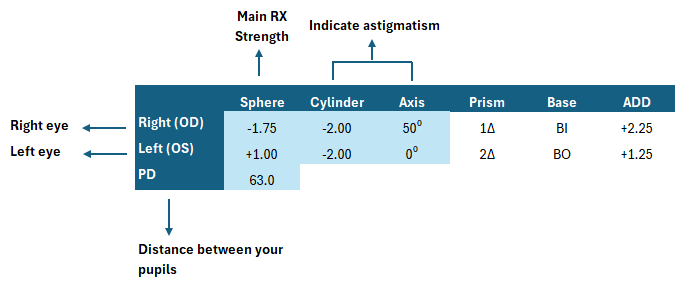
OS vs. OD
The table on your prescription typically includes two rows, one for each eye:
- OS or LE: These abbreviations indicate your left eye. OS stands for the Latin term “oculus sinister.” Some optometrists modernize their prescriptions and abbreviate “left eye” instead.
- OD or RE: “Oculus dexter” is Latin for “right eye.” Your optometrist may use “RE” instead.
The numbers listed to the right of each abbreviation relate to that eye.
Numbers in the Eye Prescription Chart
Eye care specialists determine the strength needed to correct your eyesight using diopters, a unit that measures the power of a lens. Eyesight measuring zero diopters doesn’t require any help from glasses or contacts. The farther the diopter is from zero — whether it’s positive (+) or negative (-) — the more correction you need.
Understanding Your Eye Prescription
Your eyeglass prescription uses numbers and abbreviations to describe how your eyes focus light and the lens power needed for clear vision.
Prescription Numbers
| Prescription | What It Means | Common Vision Problem |
|---|---|---|
| Negative (-) | Nearsightedness (myopia) | Difficulty seeing distant objects clearly. Higher negative numbers indicate stronger correction. High myopia is generally -5.00 or greater. |
| Positive (+) | Farsightedness (hyperopia) | Difficulty seeing nearby objects clearly. Higher positive numbers require more correction. High hyperopia is generally +3.00 or greater. |
Common Prescription Terms
| Term | Meaning |
| SPH (Sphere) | The main lens power needed to correct nearsightedness or Farsightedness. If you don’t have astigmatism, SPH may be the only value on your prescription. |
| CYL (Cylinder) | Measures the amount of astigmatism. This field is blank if you don’t have astigmatism. |
| Axis | A number between 0° and 180° that shows the orientation of your Astigmatism. The axis only appears when a CYL value is present. |
ADD (Reading Addition)
The ADD value is used when you need different prescriptions for distance and near vision in the same pair of glasses. It is added to your SPH value to create the reading prescription in the lower portion of the lens.
Types of Multifocal Lenses
| Lens Type | How It Works |
|---|---|
| Bifocals | Two distinct prescription areas separated by a visible line. The top corrects distance vision, and the bottom is for reading. |
| Progressive Lenses (PALs) | Provide a smooth, line-free transition from distance to intermediate and near vision. The rate of transition varies by lens design and manufacturer. |
Prism
Prism correction is prescribed for people with double vision (diplopia). It bends light so images focus correctly on the retina, allowing you to see a single, clear image.
Prism Base Directions
| Abbreviation | Meaning |
| BU | Base Up |
| BD | Base Down |
| BI | Base In |
| BO | Base Out |
Cosmetically, no one can tell that glasses have prism correction. The lens may be slightly thicker if you require more than one prism.
Alternative to Eyeglasses: LASIK Surgery
While understanding your eyeglass prescription is important, some people prefer to reduce or eliminate their dependence on glasses altogether. LASIK (Laser-Assisted In Situ Keratomileusis) surgery offers a permanent vision correction solution for many people with refractive errors like nearsightedness, farsightedness, and astigmatism. With LASIK, you can potentially free yourself from having to decipher complex prescriptions and manage eyeglasses. However, it’s important to discuss with your eye care provider whether you’re a good candidate for this procedure, as not everyone is eligible for LASIK surgery.
Schedule Your Free Consultation Now!
Reference:
Clinic, C. (2024b, December 16). Got a New Eye Prescription? Here’s What It Means. Cleveland Clinic. https://health.clevelandclinic.org/how-to-read-your-eye-prescription
Categories