
Tired of relying on reading glasses?
If you’re over 40 and finding it harder to read menus, text messages, or books, you may have presbyopia. Monovision LASIK is a laser vision correction procedure that helps reduce or eliminate the need for reading glasses by improving both near and distance vision.
Understanding Presbyopia
Presbyopia is a natural part of aging that makes it harder to focus on nearby objects. It happens because the eye’s lens gradually loses flexibility, typically beginning around age 40.
Common symptoms include:
- Blurry near vision
- Holding reading material farther away
- Eye strain during close-up tasks
- Frequent headaches
What Is Monovision LASIK?
Monovision LASIK surgery corrects one eye for distance vision and the other for near vision. Your brain learns to use each eye for different tasks, providing a wider range of vision with less dependence on reading glasses or bifocals.
Key Features of Monovision LASIK for Presbyopia
- Precision Correction: Adjusts one eye for close-up tasks and the other for distance, providing a balanced vision for daily activities.
- Customizable Approach: Personalized for each patient’s visual needs and lifestyle preferences.
- Reduced Dependence on Glasses: Most patients find that their need for reading glasses or bifocals is significantly reduced or eliminated.
The Benefits of Monovision LASIK for Presbyopia
Monovision offers several compelling advantages for those experiencing presbyopia. Below are some of the key benefits that patients may experience:
- Clearer vision for both near and far tasks
- Reduced need for reading glasses
- Long-lasting vision correction
- Greater convenience for work, travel, and hobbies
- Less eye strain from switching between glasses
Who is a Good Candidate for Monovision LASIK?
Monovision LASIK may be a suitable option for adults over 40 who:
- Have presbyopia
- Have healthy eyes and corneas
- Do not have any significant underlying eye conditions
- Are bothered by their dependence on reading glasses
- Have realistic expectations about the results of LASIK surgery
During a comprehensive pre-operative consultation, your ophthalmologist will evaluate your candidacy for Monovision LASIK. They will assess your eye health, measure your corneas, and discuss your individual vision needs and goals.
Potential Risks and Considerations with Monovision LASIK
While Monovision offers numerous advantages, understanding the potential limitations and risks is essential. Although rare, patients may experience:
- Adjustment Period: Adjusting to Monovision can take time. Initially, the brain may take several weeks to adapt to the new way of seeing.
- Visual Imbalance or Depth Perception Issues: Some patients report difficulty with depth perception or nighttime driving, particularly in low-light conditions.
- Slight Reduction in Visual Acuity: A small number of patients may notice that the overall sharpness of their vision is less than with full-distance LASIK.
Monovision LASIK vs. Full-Distance LASIK for Presbyopia
Understanding the difference between Monovision LASIK and traditional LASIK is important when choosing the right procedure for presbyopia.
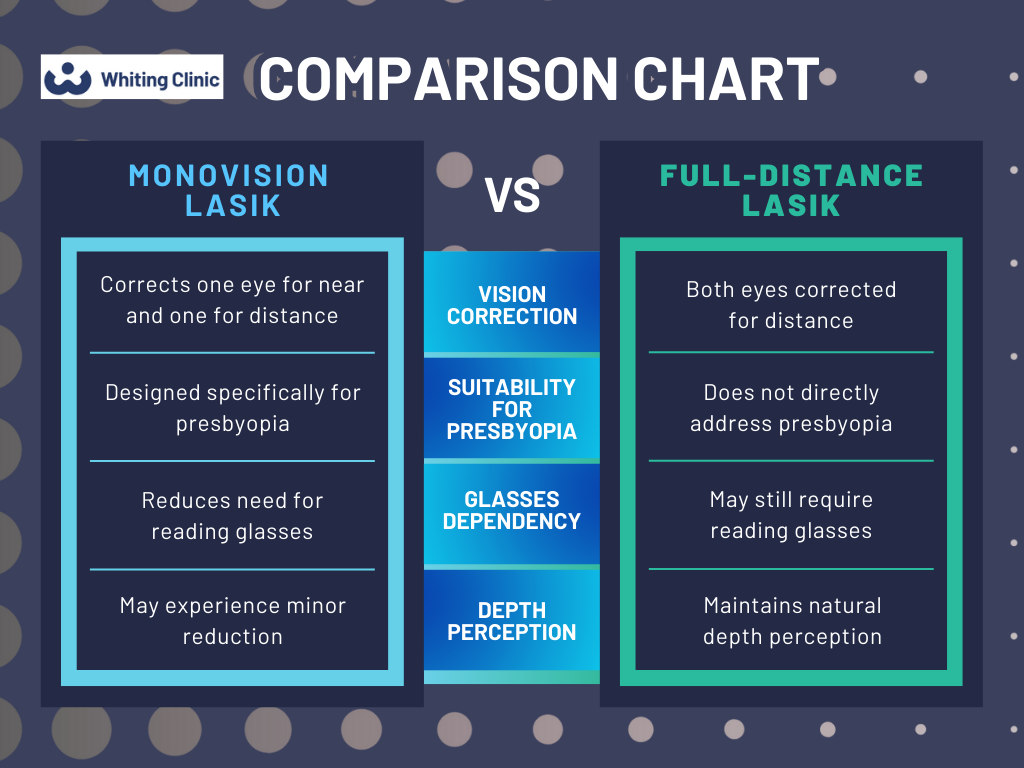
While full-distance LASIK improves far vision and enhances overall acuity, it does not address near-vision issues related to presbyopia. Monovision uniquely targets presbyopia, allowing for a customized approach that adapts to the aging eye’s needs.
FAQs:
Q: Will Monovision LASIK affect my depth perception?
A: Some patients may experience mild adjustments in depth perception. Typically, the brain adapts over time, and most individuals notice minimal impact on daily activities.
Q: How long will the results of Monovision LASIK last?
A: The results of Monovision LASIK are generally long-lasting. However, as the eye continues to age, some patients may experience additional vision changes that may warrant further corrective measures.
Q: Can Monovision LASIK be reversed if I don’t like the results?
A: If Monovision LASIK does not suit a patient’s lifestyle, enhancements can sometimes be made to revert to full-distance vision correction, though this is rare. It’s essential to have a thorough discussion with an eye specialist to weigh all options.
Ready to explore if Monovision LASIK is right for you?
Deciding on Monovision LASIK involves careful consideration of personal visual goals and lifestyle needs. For patients over 40 dealing with presbyopia and desiring more independence from glasses, Monovision may offer a life-enhancing solution. This procedure is highly individualized, and consulting with an experienced LASIK surgeon will help determine if this option aligns with your vision correction goals.
Sources:
LASIK surgery: Is it right for you? (2023, June 27). Mayo Clinic. https://www.mayoclinic.org/tests-procedures/lasik-eye-surgery/in-depth/lasik-surgery/art-20045751
Professional, C. C. M. (n.d.). Presbyopia. Cleveland Clinic. https://my.clevelandclinic.org/health/diseases/8577-presbyopia
Monovision LASIK – EyeWiki. (2023, October 3). https://eyewiki.aao.org/Monovision_LASIK
Categories